





Cellar Classic Winery Series

We welcome you to the timeless art that is winemaking! With these easy
step-by-step instructions, you can produce top quality wines in a reasonably
short time – and at little cost. If this is your first batch, rest assured that you will
soon be serving wine as delectable as the vintages you used to buy at the store.
It’s as simple as following the steps that are clearly laid out for you. If you have
made wine before, you will note that our process varies little from standard
winemaking procedures.

Please read the instructions carefully before you begin.

Important:
Please Read All Instructions Carefully Before Proceeding

Before you begin, the importance of sanitation in the winemaking process can not be stressed enough. Everything that touches your wine (all equipment) must be sanitized with a recognized sanitizing solution. Just as important is thoroughly rinsing off all equipment after the sanitation procedure.
Please use the following instructions as outlined taking care to measure the specific gravity. This allows the wine to tell you when to proceed to the next step. If you have any questions beyond these instructions please contact your local winemaking supply store or call our help line.

Now, let’s begin!

Required Equipment

Primary Fermenter:
Food-grade plastic container (27-46 litre) with cover. Fermenter should be well-marked at the 23 litre (5 imp gal/6 US gal) level. To do this, fill Carboy with water, pour into Fermenter, mark water level on outside of Fermenter.
Carboy – 23 litre (5 imp gal/6 US gal): Either glass (recommended) or food-grade plastic.
Airlock & Rubber Bung: One-way valve to seal Carboy at neck. Airlock must be half-filled with water and attached to Carboy when it is filled with wine.
Siphon Assembly: 4 feet of food-grade plastic tubing attached to a rigid acrylic rod.
Hydrometer & Test Cylinder: Measures specific gravity to monitor fermentation & sugar levels.
Spoon: Food-grade plastic, approximately 28in./70cm. long.
Package of Cleaner
Package of Sulphite
Suggested Equipment
Measuring Cup:
2 cup/500 ml.
Floating Thermometer: Tracks fermentation temperature.
Wine Thief: To remove wine samples from primary or carboy.
30 Wine Bottles: 750 ml.
30 Wine Bottle Closures: Synthetic or high grade corks are recommended to maintain the integrity of the wine.
Corker: Used with corks only. This can be rented from a retailer.
Bottle-filling Wand
Additives (included in kit)
Package 1: Bentonite Also in Kit:
Package 2A: Sulphite RJ Spagnols yeast
Package 2B: Potassium Sorbate (contains 2 packages) Oak powder or chips
Package D1: Kieselsol Crushed Grape Skins
Package D2: Chitosan Hop Straining bag

Brand:
Wine Style:
Product Date Code: (on box label)
Primary Fermentation (Specific Gravity 1.095-1.110)

DAY 1
Date:
SG:
1. Clean and sanitize Primary Fermenter, Lid, Wine Thief, Test Cylinder & Spoon. Make sure
everything is well-rinsed before you begin.
2. Add 4 litres of warm water to the Primary Fermenter. Stirring constantly, slowly add Pkg. #1
Bentonite to water until dispersed.
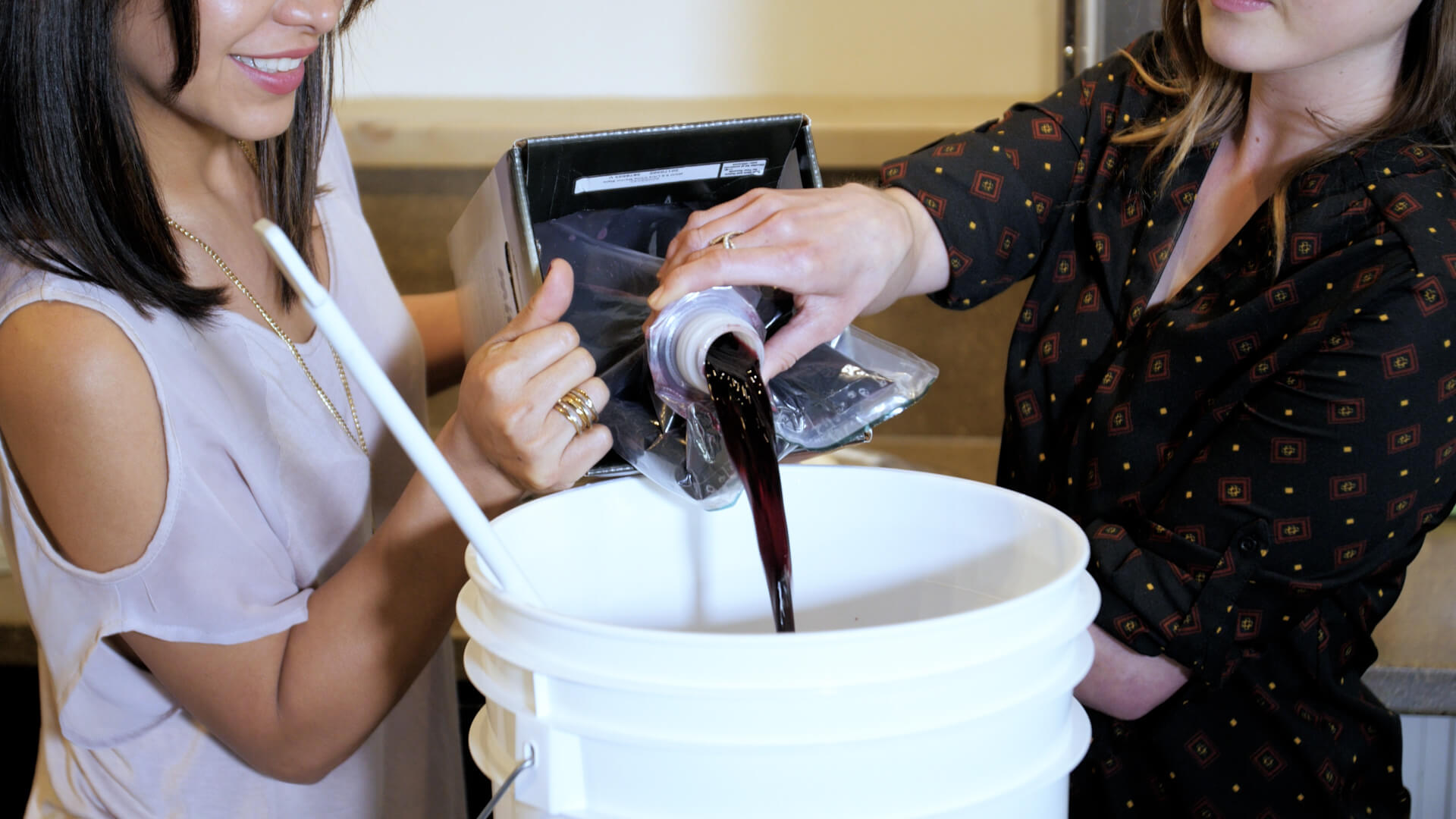
3. Empty contents of juice/Concentrate Bag into mixture in Primary Fermenter.
4. Rinse Bag with hot water and add to Primary Fermenter.
5. Add cool water to Primary Fermenter up to the 23 litre (5 imp gal/6 US gal) mark. Check to make sure the water temperature in Primary Fermenter is between 20-25°C/70-80°F. Stir vigorously.

NOTE: Some wine kits may contain Oak powder/chips.
Oak powder/chips – If your wine kit does, open it and add it now. Stir vigorously.
Dehydrated fruit – If your wine kit does, rehydrate in hot water and add mixture
to primary fermenter. Stir vigorously.
Oak chip infusion bag (resembling a tea bag) – If your wine kit does, soak it
submersed in 1 cup of hot water for 10 min. Do not open infusion bag. Add water
and infusion bag to primary fermenter.
6. Empty Contents of “Grape Skin Jar” into a clean sanitized
straining bag (enclosed). Tie the bag securely and place in
primary fermenter.

NOTE: Using a sanitized spoon, gently stir the “Grape Skin” down daily
during primary fermentation stage.
NOTE: The addition of Crushed Grape Skins will cause the level to rise above the 23 litre mark –this is normal.8
7. Using a wine thief, fill the test cyclinder. Record Specific gravity. For a table wine it should be 1.095-1.100 (depending on the wine kit).
8. Sprinkle yeast over the surface of the juice. Do not stir.
9. Place cover (or lid with Airlock and Rubber Bung) onto Primary Fermenter. If Airlock and
bung are used fill the Airlock half-full of water or mild sulphite solution.
10. Place Primary Fermenter in a warm, raised area about 3- 4 feet high, where it will be undisturbed.
NOTE: Within 2 days the wine will show signs of fermentation (bubbling or foaming). If this does not happen,call your retailer.

Secondary Fermentation (Specific Gravity 1.020 or lower)

DAY 6-8 (approx.)
Date:
SG:
1. Clean and sanitize Siphon Assembly and Carboy. Make sure everything is well-rinsed before you begin.
2. Gently siphon wine from Primary Fermenter into Carboy. Be careful not to disturb the sediment on the bottom of the Primary Fermenter. Discard sediment. Squeeze out grape skins to maximize colour and tannin extraction.
3. Place Airlock and Rubber Bung back onto Carboy and let sit undisturbed until specific gravity is 1.000 or lower at 20-24°C/68-75°F.

Stabilizing & Clearing (Specific Gravity 1.000 or lower)

NOTE: For those making Winery Series Syrah, the final gravity will be .999-1.003, this is normal.

DAY 28 (approx.)
Date:
SG:
1. Clean and sanitize Siphon Assembly, Primary bucket or 23L (6 US Gal) carboy and
Long Handled Spoon. Make sure everything is well rinsed before you begin.
2. Siphon the wine into the sterilized primary bucket or 23L (6 US
gal.) carboy. Do not disturb the sediment (called “lees” in winemaking terms) during this racking. Discard sediment in primary fermenter.
3. Add Pkg. #2A Sulphite to the wine and stir vigorously.
4. Add Pkg. #2B Potassium Sorbate (please add both packages) to the wine and stir vigorously.
5. Important: Degas wine vigorously for 5 minutes by stirring with the handle of a spoon or with a drill mounted stirring device.
INSUFFICIENT STIRRING WILL PREVENT THE WINE FROM CLEARING ADEQUATELY.
6. Add Packet D1 (Kieselsol) to wine and stir for 1 minute. Then add D2 (Chitosan) and stir well. Important: Do not reverse the order of Kieselsol and Chitosan. Degass wine for 5 minutes by stirring vigorously.
7. If in primary bucket, rack back into carboy. Attach bung and airlock.
8. Top up with water to within two inches of the airlock. Attach bung and airlock.
9. Let wine stand until Day 42 in an elevated place cool area (15-19ºC/59-66ºF).
Bottling & Corking

DAY 42
Date:
SG:
NOTE: Only crystal clear wine is suitable for bottling. If wine is cloudy, wait an additional few days for wine to
clear. At this point you may wish to filter (polish) your wine prior to bottling.
1. Clean and sanitize the Primary Fermenter, Siphon Assembly and Wine Bottles. Make sure
everything is well-rinsed before you begin.
2. Siphon the wine into Primary Fermenter. (Filtering optional)
3. Siphon the wine into Wine Bottles, leaving an inch from estimated bottom of inserted Cork.
4. Insert Corks using proper corking machine.
5. Keep Wine Bottles upright for 1 day. Then age Wine Bottles on their sides to keep Corks moist.
6. Keep your wine in a temperature-controlled environment (less than 16°C /60°F) out of direct light, for 2-3 months prior to consuming.

Enjoy!
Please use good judgement in the consumption of alcohol.
Do not drink and drive.

QUESTIONS OR COMMENTS?
Please contact your local home winemaking shop or in
Canada and the United States call our toll-free help line
1-800-663-0954
or fax us toll-free at
1-888-557-7557
www.rjspagnols.com
info@rjspagnols.com
©2007RJS
27194 INST SHT NEW CC WINERY 3